Celebrating 135 Years: Bishop Spalding's Dedication Address from 1891
Goldie Rapp
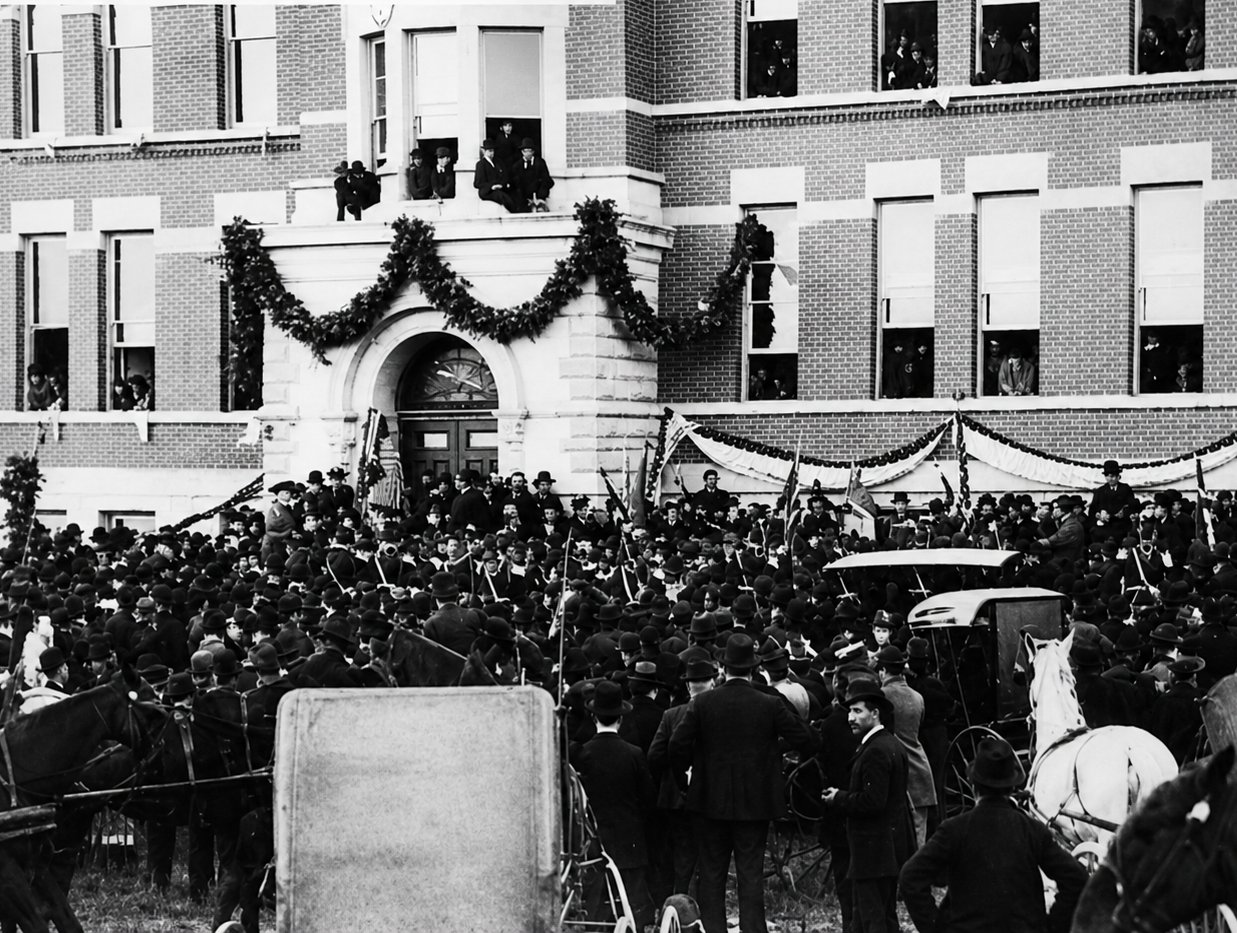
Dedication Day, October 12, 1891, of Saint Bede College. People from all over the Illinois Valley and beyond gathered to witness the opening of the new Benedictine college.
Address of Right Rev. J. L. Spalding, D.D., Bishop of Peoria.
Delivered at the Dedication of St. Bede College, Peru, Ill.,
October 12. 1891.
The founding of St. Bede's College by the order of St. Benedict in the Valley of the Illinois is not merely an interesting event, it is also a fact which is pregnant with promise of good.
From this spot we have a view of a country which is as fair as it is fertile, and which, already populous, is destined to become the busiest hive of human industry. Beneath the black soil lie inexhaustible coal-measures hardly blacker. The climate is at once wholesome and invigorating, and the people who have taken possession of this favored region, have in their veins the blood which for more than a thousand years has nourished the hearts of conquerors and subduers. They belong to that race which has never quailed before hostile man or forbidding nature, and which has acknowledged as its superior only the almighty God.
Already, a hundred miles away, they have within fifty years built a metropolis, which in wealth and population is the rival of the great cities of the world and which even now is preparing to exhibit to the nations of the earth the palpable proofs of the almost incredible growth and progress of the Western hemisphere. The State of Illinois, which half a century ago was almost a wilderness, is now cultivated like Belgium or Lombardy. Its villages are counted by the thousand, its towns by the hundred; and whithersoever we turn we behold streaming in the air the black pennon of the mighty engine which bears over the trembling plain bounteous gifts to pour them into the lap of peoples which are separated from us by oceans and by every divergence of tongue and character. At our feet, where the Illinois cautiously feels its way, as though its waters forbode and dread the tossings of the wild and turbulent sea in a very short time, a great ship-canal will pass to bind the lakes with the gulf of Mexico, and but a few miles lower down another canal will unite the Mississippi with the Illinois. We are in the heart of the great continent, in the center of commerce and manufacture, with lines of communication, East and West, North and South. There are interests too, of a more spiritual nature, which cluster here to dedicate this spot to religion and to the cause of education. Along this valley passed the early explorers and discoverers, who seemed already to foresee that the rivers which make an open highway between the lakes and the gulf, were destined by Providence to help bring about a union of hearts and minds among millions of men, who should have but one law as they adore but one God. In the plain which lies beneath us the holy Sacrifice was offered and the gospel was preached when the colonists of New England were still engaged in fierce conflicts with the Indians, when feuds and revolts were threatening the existence of the struggling settlements of Virginia and Maryland, when Manhattan Island which the Dutch had bought from the natives for twenty four dollars, did not contain a population of fifteen hundred souls. From the College windows "Starved Rock" looms before us, overlooking the valley where stood the original Kaskaskia, when Father Marquette, the discoverer of the Mississippi established the mission of the Immaculate Conception, and on Holy Thursday, in the year 1675, in the presence of 2,000 warriors and countless women and children, said the first Mass ever celebrated in Illinois, which alas was the last act of his noble and heroic life, for almost immediately afterwards he set forth on his journey northward only to be taken from his birchen canoe to die in the wilderness.
He was followed by Father Allouez, the founder of many missions, who on the 3rd of May 1676, erected in the midst of the village a cross 25 feet high, which stood for years in the plain that stretches away from the little town of Utica. Here too, Father Ribourde, a noble Burgundian and the companion of La Salle, preached the gospel, and fell beneath the Tomahawk, when the Illinois fled before the terrible Iroquois. Here also labored Father Rale, who more than a quarter of a century later was murdered by the English, while offering his life as a sacrifice for his beloved Abenakis. Associations of yet another kind which are more intimately related to the history of our own country, also gather here; for the spot on which we stand was once the property of our greatest orator, of him, whose lofty thought and majestic style have clothed the constitutional principles of our government with the splendor of genius — Daniel Webster, our least mortal mind, who in his high prescience foresaw the disruption of our country, and saw that God would make it whole again.
They who have chosen this spot as the site of a college and monastery, have not acted without wisdom. The sons of St. Benedict inherit a taste for the beauties of nature. Their cradle on Monte Cassino overlooks the dreaming hills and the rich valleys which stretch far away to dip themselves in the blue waters of the Bay of Naples: and from that eminence, where they supplanted Apollo, the god of light and beauty, they have taken flight and like the honey-laden ever-busy bees, they have settled upon a thousand heights, and on a thousand plains, to make them vocal with the ceaseless song of praise and the most pleasant noise of labor. The very ruins of the places where they abode make beautiful and consecrate the regions which lie about them.
The highest symbol and embodiment of man's spiritual and infinite nature, of his faith in God and moral consciousness, is the Catholic Church; but the mightiest and most heavenly leader of the champions of the soul, of the followers of the Blessed Christ, is Saint Benedict. If we look to what he has accomplished he stands forth from the ranks of the Saints, as Cæsar stands forth from the ranks of the heroes. As the great Roman shaped the course of Empire for more than a thousand years, so the founder of Western monasticism directed for centuries the progress and development of Christian life and civilization. More than all others he understood how to harmonize man's yearning for temporal power and dominion, for knowledge and freedom, with the genius of the religion of Christ whose Eye is forever bent on the Eternal and Infinite. The history of his order is the highest evidence that faith and love, humility and patience, are the saving principles. They fertilize the earth, illumine the mind, strengthen the heart and people heaven with elect souls. From his brotherhood sprang the two popes, who in their influence upon the Church take precedence of all others—Gregory the Great and Gregory VII. St. Maur, a disciple of St. Benedict, carried the order to France where in a short time it absorbed the flourishing communities founded by St. Columbanus, and spread rapidly throughout the Frankish kingdoms. St. Augustin carried it to England, and it became the paramount influence in converting and moulding the Anglo-Saxon race. St. Wilfrid, St. Willibrord and St. Boniface carried it to Holland and Germany, and these great Benedictines hold their undisputed place in history as the apostles of the Teutonic peoples. From the tomb of Boniface at Fulda, the monastic brotherhood spread through the whole fatherland, as in England it spread from Canterbury, and wherever the monks encamped, the forest was felled, the marsh was drained, the school was built and the barbarous population was brought under the influence of religion and law.
In the midst of universal ignorance these monasteries became the centres of learning, the storehouses of all that remained of sacred and profane literature; and from them there issued forth a ceaseless stream of enlightened teachers, and holy rulers. The knowledge of what was then accomplished led Charlemagne to decree that a school should be attached to every monastery and every cathedral throughout the empire. In this apostolic epoch, in the history of the order, the Benedictines were the heroes, who amidst the irruptions of barbarous hordes, amid the clash of arms and the wild confusion of unrestrained cruelty and lust, stood undaunted, their hearts raised to heaven, while their hands held the plough and the pen. They were the men of light and reason, who looking up to the Father in heaven, put their trust in knowledge and labor; they appealed from the brutal courage of the barbarian, who exulted amid the ruins he had made, to the all-conquering moral power of religious faith, which makes man patient and strong in the consciousness that he works with God to upbuild an enduring society, where they who know and love dwell with the Eternal. These monastic schools taught the whole cycle of human knowledge: philosophy, theology, mathematics, natural science, poetry, rhetoric and music as well as classical and sacred literature. Of Alcuin, one of these monks, the friend and counsellor of Charlemagne, Guizot says: "He is a monk, a deacon, the light of the contemporaneous church; but he is at the same time a scholar, a classical man of letters." When we reflect that the Benedictines, in their heroic age, to perfect faith, to blamelessness of life, to dauntless courage, to the spirit of tireless labor, joined the best culture of mind, then possible, we need not stop to examine into the causes of their phenomenal success. In spite of the jealousy and envy which great merit excites, true worth wins its way to the heart of man. We fatally turn to those who have the power and the will to help us; for we all are weak and would be strong; we all are ignorant and would have knowledge; we all are timid and confused, and would follow those who have an eye to see and a heart to lead. When men are pure, devout and humble, and also enlightened, intrepid and active, the world will hearken to their voice and drink the inspiration of their lives; and they who, by habitual self-denial attain to knowledge and virtue, become the natural guides and rulers of their fellows.
In what marvelous degree the order of St. Benedict has succeeded in giving such men to the world we may see at a glance. By the middle of the 14th. century, 24 of its members had sat upon the Chair of St. Peter, 200 had been Cardinals, 7000 had been Archbishops, 15,000 had been Bishops, and upon more than 50,000 the title of Saint had been conferred by the voice of the people or the church. To them chiefly the world is indebted for the conversion of the Germanic peoples, for upbuilding the kingdoms of France and England; to them for bringing under cultivation vast tracts of waste land, for training innumerable barbarous populations to till the soil; to them, for keeping alive in the West the traditions of intellectual culture and for preserving the classical writings. Every monastery, according to the rule of St. Benedict was to have a library and every monk to possess a pen and tablet. To them also the world is indebted for their fearless insistance upon the principle that neither obscure birth, nor poverty, nor bodily weakness are barriers to eminence; that opportunity should be given to slaves and beggars, who, if they are found worthiest, should be made Popes and Kings. To them, notably to Gregory the Great, Guido D'Arezzo and Ockenheim, we are indebted for the cultivation and improvement of sacred music, of which our modern music, the distinctive art of the 19th. century, is but a development. I will not however insist upon the services which the Benedictines have rendered, nor shall I attempt to conceal the abuses, which, here and there, and again and again, have crept into the order during the 14 centuries of its existence.
A religious order is but a human institution, and the Church itself, which is of divine origin, has its epochs of weakness and decadence. I do not now recall the name of the Cardinal, who, when there was question of giving the highest ecclesiastical sanction to the Society of Jesus, opposed it on the ground that the good done by religious orders in the fervor of their early years, is more than counterbalanced by the harm they do when, as it always happens, discipline becomes relaxed and the heroic virtue of the founders and first disciples gives place to indifference and self-indulgence. Whatever truth there may be in this view, it did not meet with the approval of the Pope, although a committee of Cardinals, of whom Reginald Pole was one, had but two years before made a report to him, in which they declared that they were of opinion that all the religious orders should be suppressed.
It was a disciple of St. Benedict, himself a Saint, and a Monk and a Pope as well, Gregory the Great, who wrote: "It is better to have scandal than a lie"; and the Monks who wrote the annals of their orders, did not seek to conceal the abuses which had crept into them. "I contend," says St. Bernard, "not against, but for the Monastic Order, when I expose the vices of men who make part of it." It was left to the half doubting faith of weaker ages to imagine that the best way to make wrong right is to deny its existence.
It is but truth however to say that the abuses which have enfeebled and tainted the life of so many orders, have been misunderstood and exaggerated. They have nearly always arisen from the invasion of the temporal power. Kings and princes and statesmen, under the vicious system, known as the Commende, which began to prevail early in the middle ages and spread widely throughout Europe, claimed the right to place their favorites as superiors over religious houses, and under the rule of such men, the vices of the world fatally made their way to the sanctuaries of religion. But when the worst is said even of those whom the world thus corrupted, all that can be truthfully affirmed is that they became self-indulgent and indolent, following the bent of human nature, which inclines to the love of ease and of the good things of earth, drifting down to a sluggish life of mere sensation and thoughtlessness.
"Vain will be any endeavor," says Montalembert, the historian of the "Monks of the West", "to alter the distinctive character of their social historical part, which is that of having lived to do good. Humanly speaking, they have done nothing else: all their career is occupied with peopling deserts, protecting the poor and enriching the world. Sadly degenerated towards their decline, much less active and less industrious than in their origin, they never became less charitable. Where is the country, where is the man whom they have injured? Where are the monuments of their oppression? the memorials of their rapacity? If we follow the furrow which they have dug through history, we shall find everywhere but the traces of their beneficence."
But to have done is of small account. Ingratitude to individuals is but a form of that universal unthankfulness which makes us look with a pity, akin to contempt upon whatever thing or institution which, having been great and strong, is now reduced to nullity. Men will not love the Church or its religious orders for what may have been done. The old, who are sinking beneath life's rapid current, may seek to prolong a feeble existence by cherishing memories of things that have passed away, but the young and vigorous turn with eager expectancy to what is now capable of nourishing the mind, the heart and the soul. Our religion is divine not because it has blossomed forth in former ages, in the lives of virgins and apostles, of martyrs and confessors; nor yet because through its inspiration, genius in every form of artistic expression, has clothed the highest thought with perfect beauty, breathing harmony, giving movement to stone, speech to canvas, and to human language the power to utter immortal truth and godlike love, in cadence and melody, which like the music of higher worlds, like the cradle songs of childhood's lost paradise, linger forever in memory to soothe, uplift and console the heart of man: but it is divine because it contains the germs of an everpresent, infinite life, which seems to wane and die only to be born again, amid other environments, with a vigor and a beauty, which are always fresh and delightful.
And it is the glory of the order of St. Benedict that though like the Church, it has again and again seemed about to be overwhelmed by the calamities of the times and the force of human passion, yet like the fair mother of souls, it has again and again in the long course of ages, risen superior to fate, and gathering into its ranks the children of new generations, addressed itself to deeds of light and beneficence.
When nearly three centuries after its foundation, the troubled and barbarous state of the world had led to a relaxation of discipline in innumerable monasteries, St. Benedict of Amian arose and finally succeeded in reforming almost the entire order, which then entered upon its most brilliant period of service to the cause of religion and civilization, of science and literature.
When the Empire of the Franks was invaded by the Normans and the Huns, from the West and the East, who pillaged the convents and dispersed the Monks, the general ruin brought disorder also in the cloisters. The ninth and tenth centuries are the age of darkness and confusion. But even in this epoch of chaos a new and salutary movement was begun among the Benedictines. Hitherto each monastery had stood alone and independent; but now mother-houses were constituted which imposed their rule upon the affiliated convents and watched over the observance of discipline. Upon this plan the congregation of Cluny was established in France, the congregation of Camaldoli in Italy, the congregation of Vallombrosa in Tuscany, and the congregation of Hirschau in Germany, which have all a great and noble history.
In England a similar reformation was brought about by St. Dunstan, who caused the old life in its peace and fruitfulness, to flourish again. During the eleventh century new branches sprang from the parent trunk such as those of Granmont and Cîteaux, the latter of which, the genius and courage of St. Bernard pushed so vigorously forward that it rapidly spread through Europe, and within a century of its foundation embraced eight hundred rich Abbeys; and when towards the end of the twelfth century its immense wealth began to act unfavorably upon discipline, John de la Barriere, after a considerable lapse of time, succeeded in effecting a reform which gave rise to the Feuillants in France and to the Bernardines in Italy. Another salutary reformation brought about by Didier de la Cour in the Convent of St. Vanne, in the sixteenth century, renewed the religious life of the Benedictine Monasteries of Lorraine, Alsace and Burgundy. Intimately associated with Saint Vanne is the reformation introduced in the convent of St. Augustin of Limoges in the early part of the seventeenth century, which gave rise to the celebrated congregation of Saint Maur, which embraced a hundred and twenty four abbeys, the centres of a literary activity that extended to every branch of science, and enriched the world with works, which will remain as monuments of patient research and profound erudition.
The French Revolution which upheaved and overturned everything, suppressed the Benedictine Order in France, Spain and Germany; as in England the Protestant Reformation had swept away its hundred and eighty six Abbeys and Priories. But it has again sprung to life and established itself in the chief countries of Europe. It was introduced into Pennsylvania in 1846 by a colony of monks from Bavaria; and from the Abbey of St. Vincent it has spread through the country in many directions, and that its activity has not ceased the opening of this College of St. Bede to-day is evidence enough.
Here, indeed, there is little to recall the conditions, physical, moral and intellectual, which existed when the Benedictine Monasteries and Schools were established throughout Europe in the early middle ages. No barbarous hordes will come to destroy these buildings; Kings and Princes will not have power to appoint here unworthy superiors, and the people by whom they are surrounded are neither ignorant nor pagan, for the marvelous material development of the West has not been unaccompanied by religious and intellectual improvement. If the thousands of Indians, who heard the first Mass said in Illinois, have with their descendants passed away to sink into the ocean of oblivion and nothingness, the faith has not perished with them. On the contrary it lives in this great State with an energy and freshness which might make us forget that it comes down to us from ages when our rude ancestors had not yet emerged from their dense forests to overrun the world and to fill it with terror and ruin. There are in Illinois to day more than six hundred Catholic churches and nearly seven hundred priests, and our schools, asylums and institutions of beneficence are scattered all over the state. And to perceive how rapid is the development of our ecclesiastical organization, we need but consider that in this diocese of Peoria, where at the time of its formation, fourteen years ago, there were not fifty priests, including those who were in the five counties since added to it, there are now a hundred and thirty, and that whereas then there were not in its present territory more than ninety churches, there are now a hundred and seventy; and it is but truth to say that among the strong and active people in the midst of whom we live, none are more intrepid, more laborious, more eager to take advantage of whatever opportunities are offered to promote the spiritual and temporal welfare of their fellow men than the Catholic priests. They instruct, they guide, they build, and while they insist upon righteousness and plead for interests which are eternal, nothing that concerns the welfare of man is foreign to their thought. I will not speak of their patriotism, for to boast of one's patriotism is to lay one's self open to suspicion, and is, besides as much a breach of good taste as to boast of one's virtue; but I think I may say without risk that they believe in freedom and in education as they believe in God and in Christ.
In their name and with them, Rt. Rev. and Rev. Fathers, I welcome you to this diocese of Peoria. You come, in a sense to be our teachers and guides; for whatever fervor of faith and piety, whatever illumination of mind is shed from here, will warm and light us all.
The principles which underlie the religious life are divine. It is forever and everywhere right to be gentle and lowly of heart, to be obedient to law, to be chaste in thought and act, to prefer the good which lies within us to whatever is merely external. To pray, to toil, to study, to write, to speak, to live plainly and to think nobly, because such life is godlike and because it brings blessings to men—this is your aim, this your vocation.
To spread peace and faith, freedom and good will, science and art, light and life;—this is your work.
Your rule, says the most eloquent voice ever uplifted in advocacy of religious truth, “is an epitome of Christianity, a learned and mysterious abridgement of all the doctrines of the gospel, all the institutions of the Holy Fathers and all the counsels of perfection. Here prudence and simplicity, humility and courage, severity and gentleness, freedom and dependence eminently appear. Here correction has all its firmness, condescension all its charm, command all its vigor, and obedience all its repose; silence its gravity and words their grace, strength its exercise, and weakness its support; and yet always, my Fathers, he calls it a beginning to keep you always in holy fear.
You bring to our young and vigorous life, the charm and mystery of the past, the poetry and romance of the marvelous creative Middle Age. You knew the Rome of the Cæsars, before it had been despoiled by the invader and the envious tooth of all-destroying time. You were present when century after century the onrushing hordes trampled whatever was great or beautiful beneath the hoofs of their wild steeds. You saw the new world begin to take form, as islet after islet emerged from the chaotic waste, and hearkening to the voice of religion, men dared again to hope. You saw the splendid pageantry of that wondrous world which lives again in the pages of Froissart and Shakespeare, of Bocaccio and Dante. Emperors and kings, queens and princesses, have taken the habit of your order and become your brothers and sisters. You have spoken truth to popes and defied tyrants. Of all the heroes whom Carlisle has praised, none I think, was so near to his heart, as Abbot Samson, that typical Benedictine, whose foot was planted on the solid earth to maintain all justice and to defend all right; and whose faith in the unseen world was as sure and serene as though he had gazed upon it with bodily eye.
You are of ancient and noble lineage; the awful weight of a glorious past rests upon you; adown the centuries a cloud of virgins and apostles, of martyrs and heroes, whisper in the silent regions of the soul, bidding you gird yourselves for the ceaseless struggle for moral freedom over enslaving passion, for mental illumination over all-confounding ignorance. The one great purpose of all institutions of learning is to bring young and sensitive natures into living, daily and hourly contact with generous and enlightened minds. This is the vital part of education and all else is mere machinery. Ah! may the eager yearning youths who shall crowd these halls, find here as friends and teachers, men, the bare thought of whom shall have power, like Fame, to raise the clear spirit “to scorn delights and live laborious days.”
But to exhort is to reproach, and I gladly turn to the sweet and placid countenance of our Venerable Bede, as he is brought before me by the most meditative and thoughtful of poets:
But what if one, through grove or flowery mead,
Indulging thus at will the creeping feet
Of a voluptuous indolence, should meet
Thy hovering shade, O Venerable Bede!
The saint, the scholar, from a cœle freed
Of toil studious, in a hallowed seat
Of learning, where thou heard'st the billows beat
On a wild coast, rough monitors to feed
Perpetual industry; Sublime Recluse
The recreant soul that dares to shun the debt
Imposed on human kind, must first forget
Thy diligence, thy unrelaxing use
Of a long life, and in the hour of death
The last dear service of thy passing breath.
Bede is the fairest and the noblest figure of the age to which he belongs. Born in an obscure corner of the world, of the Anglo-Saxon race, which half a century before, was still hidden in the darkness of ignorance and idolatry, he stands forth not only as a historical writer of the first rank, the sole source of our knowledge of a people, whose deeds have changed the earth and filled it with their fame; but he is also a scholar of wide culture, intimately acquainted with whatever in his day was best worth knowing. A theologian, an exegete, a historian, writing and speaking at pleasure, in prose or verse, in Anglo-Saxon or in Latin, he knew besides whatever it was then possible to know of philosophy and science. Quotations from Plato, Cicero and Seneca, from Virgil, Ovid and Lucretius fall from his pen as readily as the words of the gospel itself. He is, in truth, as Edmund Burke entitles him, the "Father of English learning," the typical scholar such as the English Universities have always sought to produce. In the midst of a life of ceaseless intellectual toil, he still preserves the fresh fervour of his youthful piety, closing the list of his literary labors with this touching prayer: "Oh, good Jesus, who hast deigned to refresh my soul with the sweet streams of knowledge, grant that I may one day mount to Thee, who art the source of all wisdom, to remain forever in thy divine presence."
And what simple winsomeness there not in these words concerning himself: "Having been sent by my relations, at the age of seven years, to be educated, I have ever since lived in this monastery, where I have diligently pondered the Scriptures, and while observing the rule and chanting daily in choir, I have always felt it to be a pleasant thing either to learn, or to teach or to write." His death was as beautiful as his life was fair and fruitful. During all his illness he ceased not from teaching and dictating, and when the evening of the last day was come, one of his disciples said to him: "Beloved master, there remains but one word to write." "Write it quickly" he answered; and when it was completed the disciple said: "Now it is finished". "You say truly, it is finished", the Saint replied. "Take my head in your arms and turn me, for I have great consolation in looking towards the holy place where I have prayed so much;" and then he passed to the unseen world.
O happy omen, that this college and monastery are to bear a name so full of warmth and light! Here too shall be found servants of God, lovers of men, bright stars of the monastic brotherhood, who, here where the echo of the warwhoop died away but yesterday, shall walk in the ways of peace and of wisdom, shall teach knowledge and shed upon fair young souls the light of faith and the glow of heavenly love. As the harvest reaped in these fertile fields is sent over seas and oceans to nourish millions; as the coal underlying our feet is distributed through distant regions of the North, to warm and cheer the homes of thousands, so shall there gather here from year to year a swarm of youths athirst, who drinking deep at this open fountain of truth and spiritual life, shall scatter through the land, centres of influence from which high thought, true courage and noble aims shall radiate.
If I, who by birth, by training and by love, not less than by the visible environments of my actual home, belong to the West, may be permitted to express an opinion upon the character of the western people, I will say that they mistake who imagine that the energy which has wrought the material transformation of which the wide world is witness, is that of a race which can ever rest content with merely material achievements. Whether our origin be Anglo-Saxon, Celtic or German, we come of the world's best blood, belong to races to whom the ideals of religion and culture, of freedom and righteousness have ever appealed with irresistible force.
If, with incredible industry we have, within half a century, leveled the mountains and filled up the valleys and made straight the ways, who can doubt but that all this has been done, that here a free people, unhindered and unhampered, may enter upon the infinitely more arduous task of rising to heights of intellectual and moral excellence! The spirit of democracy bids us look at the man, not at his birth or surroundings: but, if while we think lightly of aristocratic descent, of the trappings of office, the vain sound of titles and the vulgar show of wealth, the best culture of mind and the noblest devotion of soul, leave us unsympathetic and unmoved, what power can save us from becoming hopelessly common and inferior? Ah! we shall not rest content until religion infuse through all our life the charm of reverence and gentleness, of modest and polite breeding, making impossible the coarseness and vulgarity which are still so manifest; until the best culture, opening to our view the whole past of the race and all the realms of nature, break down the hard and narrow walls which confine every ignorant soul, giving to each one of us the dignity, greater than that of princes, which belongs to knowledge and to thought. The impetus given to our material development is so irresistible that we can not imagine its progress should be arrested; and the machinery of our political life will be kept in some kind of order, we can not doubt, by the patriots who are ever willing to sacrifice their ease for the care and worry of office; but what we need above all things, and what I believe we most yearn for, is the man, the influence, the institution, with power to nourish the life of the soul, to give us faith, hope and love, to give us wide knowledge and great thoughts, to strengthen and refine our sense of beauty, to make us appreciative of whatever is true or divine or fair or noble.
For same such purpose, Rt. Rev. and Rev. Fathers, this college has been founded. May God's blessing rest upon it; may good men's hands be outstretched to help it; may those who year after year shall enter its halls, return to their homes, like merchants from distant lands, laden with rich store of wisdom and love; and some day, when we, who are here shall sleep with our fathers in the cool earth, let a loving hand write above its portals Bede's epitaph:
O Bede, God's servant and bright star
Of the monastic brotherhood!
From regions, which do lie afar
To the whole Church thou hast brought good.